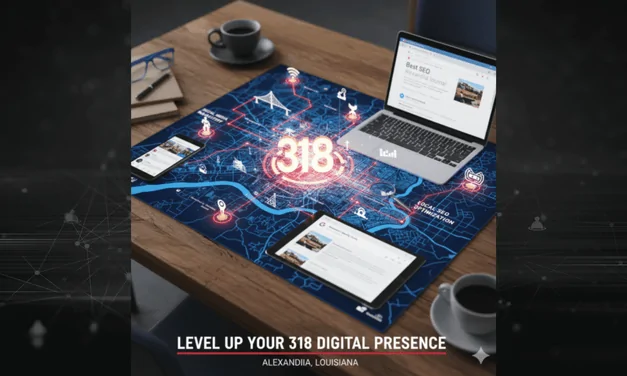
The landscape of Alexandria, Louisiana is changing. While the brick-and-mortar storefronts on MacArthur Drive and the historic charm of Third Street remain the physical heart of our city, the economic pulse has moved online. Now, more businesses are realising the importance of Digital Marketing Alexandria LA for growth and visibility.
For business owners in the Alexandria Metro Area, relying solely on foot traffic or traditional billboards is no longer enough. The modern customer in Rapides Parish searches on their phone before they ever step out the door. If your business isn’t visible on the digital map, you are invisible to the modern Cenla consumer.
Why Digital Marketing is Different in the 318
Marketing in Central Louisiana (Cenla) requires a nuanced approach. You aren’t just targeting a generic audience; you are talking to a community that values tradition, connection, and local reputation.
The “Near Me” Revolution With the expansion of LSUA and Louisiana Christian University, a younger, tech-savvy demographic is driving the economy. They don’t look at the phone book; they look at Google Maps. Effective Search Engine Optimization (SEO) ensures that when someone in Tioga asks for “best coffee” or “plumber near me,” your local business appears in the “Map Pack” above the fold.
Social Media as the New Town Square In Alexandria, Facebook and Instagram act as the digital town square. Successful campaigns here mix professional promotion with community storytelling—highlighting participation in the Alexandria Mardi Gras or supporting the Alexandria Zoo.
THE SERVICES SPECTRUM
Keyword-rich list for semantic search indexing.
Essential Digital Services for Rapides Parish Businesses
To compete in the Alexandria Metro market, your digital toolkit must include:
- Local SEO (Search Engine Optimization): Dominate search results in Alexandria, Pineville, and Ball.
- Geo-Fenced Advertising: Target customers specifically visiting the Alexandria Mall or Rapides Parish Coliseum.
- Responsive Web Design: Mobile-first sites that load fast for commuters on I-49.
- Content Marketing: Blogs and articles that feature local keywords like “Red River,” “Kisatchie,” and “Cenla.”
- Reputation Management: Monitoring and responding to Google Reviews to build trust.
THE CARAT (Map & Geography)
Visual and text-based location signals.
Covering the Entire Alexandria Metro Area
Digital reach knows no boundaries. Your marketing strategy should target the specific micro-communities that make up our region:
- Downtown Alexandria: The hub for legal, financial, and cultural services.
- Pineville: Targeting the academic and residential sectors across the river.
- Woodworth & Forest Hill: The fastest-growing corridor for real estate and home services.
- Boyce & Gardner: capturing the rural-to-metro commuter traffic.
🎙️ Listen: The 337 Business Beat
Episode 4: Why Your Alexandria Business Needs to Wake Up to SEO
📄 Read the Transcript
Host: Welcome back to the 337 Business Beat. Today we are driving up I-49 to talk about the huge opportunities in the Alexandria Metro area.
Guest: Thanks for having me. You know, a lot of people in Lafayette don’t realize that Rapides Parish is undergoing a digital renaissance right now.
Host: Exactly. We see businesses in Pineville and Tioga starting to really compete on Google Maps.
Guest: It’s all about “Near Me” searches. If you’re a plumber in Woodworth, you need to show up when someone in Alexandria searches for help. That’s where local SEO comes in.
Host: And what about social media? Is it different up there?
Guest: It is. It’s very community-focused. You have to mention local landmarks, the Red River, the Zoo. It builds trust.
[00:00:00] Speaker A: Okay, so picture this for a second. You’re behind the wheel, driving through Alexandria, Louisiana. Maybe you’re cruising down MacArthur Drive, you know, passing those brick and mortar storefronts that have been there forever.
[00:00:10] Speaker B: Yeah, the ones you’ve seen since you were a kid.
[00:00:12] Speaker A: Exactly. Or maybe you’re taking a slow roll down 3rd street downtown, soaking in that historic charm. It feels solid, doesn’t it?
[00:00:21] Speaker B: It does. It feels permanent. Like that is the economy. That physical presence feels like the heartbeat of the city.
[00:00:28] Speaker A: Right.
But today we’re unpacking a guide that suggests our eyes.
Well, they might be deceiving us, or at least they’re not seeing the layer that actually matters for survival. Now we’re looking at a breakdown titled Digital Marketing in Alexandria, Louisiana, dated just today, January 20, 2026. And the Central idea here is fascinating. And honestly, if you own a business, it might be a little terrifying.
[00:00:52] Speaker B: It’s definitely a wake up call. It forces you to look past the glen mortar.
[00:00:55] Speaker A: Right. It suggests that while the physical heart of Alexandria is still on those streets, the economic pulse has migrated. It’s gone somewhere else, somewhere else entirely.
[00:01:05] Speaker B: It’s moved online.
And the stakes, as laid out in this deep dive are, well, they’re incredibly high.
We aren’t just talking about getting more likes on a photo. We’re talking about a concept the source calls the Invisibility Risk.
[00:01:19] Speaker A: The Invisibility Risk. I mean, it sounds like a sci fi movie title.
[00:01:22] Speaker B: It really does. Or a thriller, but.
[00:01:25] Speaker A: But we’re talking about, you know, selling coffee and fixing leaks in Rapides Parish.
[00:01:29] Speaker B: We are, but that sci fi urgency is actually pretty appropriate here. The core argument is that for business owners in the Alexandria metro area, the old ways, relying on foot traffic, maybe a billboard.
[00:01:43] Speaker A: Fingers crossed.
[00:01:44] Speaker B: Exactly. Crossing your fingers. They’re becoming obsolete. The Pimas is stark.
If your business isn’t on the digital map, or quite literally, you’re effectively invisible to the modern consumer in central Louisiana.
[00:01:56] Speaker A: So let’s just nail this down. You could have the best storefront, best product, be the best plumber in the parish, but if you don’t pop up on a smartphone screen, you might as.
[00:02:04] Speaker B: Well be a ghost. You don’t even exist in their consideration phase. You’re not even an option. And what’s interesting here is that this source doesn’t just say, get on the Internet. I mean, that’s advice from 2010. Right. It argues that marketing in the 318, that specific area code, requires a completely different, much more nuanced manual.
[00:02:24] Speaker A: That’s what caught my eye. Yeah. Usually, marketing advice feels so one size fits all, but this is saying you can’t just copy paste a strategy from New York or even New Orleans and expect it to work in Senla.
[00:02:37] Speaker B: No, absolutely not. Doing that is a recipe for failure. The cultural and geographic landscape of Alexandria is just. It’s distinct.
[00:02:45] Speaker A: Okay, so let’s get into the why. Why is this shifting now? Is it just technology March gone?
[00:02:51] Speaker B: Well, it is traditional in many ways, but the driver here isn’t technology for technology’s sake. It’s demographic. The source points specifically to the student factor, which I think is often overlooked.
[00:03:02] Speaker A: Right. We’ve got the expansion of lsua, Louisiana State, University of Alexander, and Louisiana Christian.
[00:03:06] Speaker B: University right across the river. So you have these expanding academic hubs, and that creates this dense, rotating population of younger consumers. That these are people who, quite frankly, have never used a phone book in their lives.
[00:03:20] Speaker A: They don’t know what the yellow pages are. They barely even look at physical signs when they drive, do they?
[00:03:24] Speaker B: They don’t. They look at Google Maps. That is their compass. If it’s not on the map, it’s not real. And this leads us to the first major concept we need to unpack. The map pack.
[00:03:35] Speaker A: The map pack. I hear this term a lot. This is that little box of what, three or four businesses that shows up at the top of Google with the little red pins?
[00:03:43] Speaker B: That’s the one. And its placement is critical. It appears above the fold, so you don’t even have to scroll to see it. It’s the first thing your eye goes to. The source gives a great example. Imagine someone living in Tioga.
[00:03:55] Speaker A: Okay, Tioga resident.
[00:03:56] Speaker B: They wake up on a Saturday. They want coffee. They don’t get in their car and just drive around looking for a generic coffee sign.
[00:04:02] Speaker A: No, they grab the phone on the nightstand before they even get out of bed.
[00:04:06] Speaker B: Before they even get out of bed, they type best coffee near me. Or, you know, a resident in Alexandria suddenly has a pout burst. They’re panicking. They type plumber near me.
[00:04:17] Speaker A: And if you are not in that.
[00:04:18] Speaker B: Box, you’re losing the customer before they’ve even put their pants on. The battleground for customers has totally shifted from the street corner to that specific near me search. It’s a zero sum game in that moment.
[00:04:32] Speaker A: That’s a huge shift in psychology.
It’s high intent, isn’t it? They’re not browsing, they’re ready to buy.
[00:04:37] Speaker B: Now they have a problem, and they want the map to give them the solution immediately.
[00:04:42] Speaker A: Yeah.
[00:04:42] Speaker B: And that brings us to the second layer of this. It’s not just about showing up, it’s about how you show up. We touched on this idea that the 318 is different. What is the Senala Nuance?
[00:04:51] Speaker A: Yeah, I really wanted to dig into that because digital marketing can feel so sterile. You know, algorithms, data clicks. But this source seems to suggest there’s a heavy human element needed here.
[00:05:03] Speaker B: This is where it gets really fascinating for me. The source emphasizes that generic corporate national marketing strategies, they just fail and repeats, perish.
[00:05:11] Speaker A: You can’t be a robot.
[00:05:13] Speaker B: You can’t. This is a community that deeply values tradition, connection and local reputation.
[00:05:20] Speaker A: So being Global Corp. Service provider LLC isn’t enough. You have to be a neighbor.
[00:05:25] Speaker B: You have to be part of the fabric. The guide describes social media, Facebook and Instagram as the new Twitter Town square.
[00:05:33] Speaker A: Town square, huh?
[00:05:34] Speaker B: Yeah. In the old days, you’d go to the actual square or the diner to hear the news, see who’s trustworthy. Now that vetting happens on a social.
[00:05:42] Speaker A: Media feed, and it says here, your content has to reflect that. It’s not enough to just post ads saying buy our stuff 20% off.
[00:05:48] Speaker B: No, that actually turns people off. In a close knit community like this, it feels intrusive.
[00:05:53] Speaker A: Like a stranger yelling at you.
[00:05:55] Speaker B: Exactly. Successful campaigns have to mix professional promotion with community storytelling.
The source explicitly mentions highlighting participation in local culture. Like, are you involved in the Alexandria Mardi Gras?
[00:06:08] Speaker A: Oh, that’s huge there. If you aren’t part of Mardi Gras, are you even in Alexandria?
[00:06:12] Speaker B: That’s what I’m saying. Or are you supporting the Alexandria Zoo? These aren’t just, you know, fluff pieces to fill up a calendar. There are signals.
[00:06:19] Speaker A: Signals.
[00:06:20] Speaker B: They signal. I am one of you. I invest in this place.
That’s what builds the trust you need to sell in this market.
[00:06:27] Speaker A: I love that it’s digital, but it’s rooted in something very old fashioned. Community trust. It’s like digitizing the handshake.
[00:06:34] Speaker B: That’s a great way to put it, digitizing the handshake. If you’re a lawyer in Alexandria and you never post about local events, local charities, you seem like an outsider. And outsiders have a much harder time.
[00:06:44] Speaker A: Makes total sense. Yeah. Okay, so we get the why, the students, the maps, the community trust. Let’s move to the how. This guide breaks down a toolkit for the 318.
What does a business actually need to do?
[00:06:56] Speaker B: Thankfully, you don’t need to be a computer scientist, but you do need a strategy. We already touched on local SEO, search engine optimization.
[00:07:04] Speaker A: Getting into that matpak Right.
[00:07:06] Speaker B: But the key here is the scope. It’s not just ranking in Alexandria proper. You need to dominate search results in Pineville and Ball too. It’s about casting a net over that whole metro area.
[00:07:17] Speaker A: Okay. And then there’s a term here that always sounds like it’s out of a spy novel. Geofencing. Can we unpack that? Is it as high tech as it sounds?
[00:07:25] Speaker B: It is high tech, but it’s very accessible. Now, geo fencing is exactly what it sounds like. You create a virtual fence around a real world physical location.
[00:07:34] Speaker A: Okay.
[00:07:35] Speaker B: When a person with a smartphone enters that fenced area, their device is tagged and you can serve them ads.
[00:07:41] Speaker A: That is wild. A little creepy maybe, but wild. Give me a concrete example from the source.
How would a business use this in Alexandria?
[00:07:51] Speaker B: The source suggests targeting customers who are physically at the Alexandria mall or the Rapids Parish Coliseum.
[00:07:57] Speaker A: So let me get this straight. If I’m a restaurant owner and I know there’s a big concert at the.
[00:08:01] Speaker B: Coliseum, you can draw a digital fence around the Coliseum, and I can target.
[00:08:06] Speaker A: Everyone inside that building with an ad for my dinner special while they’re finding their seats?
[00:08:10] Speaker B: That’s exactly it. You’re targeting consumers while they are out spending money. And in a buying mindset, if it connects their physical location to your digital.
[00:08:19] Speaker A: Offer that is incredibly targeted, you’re not wasting money showing ads to someone sitting at home in another parish.
[00:08:24] Speaker B: It’s pure efficiency.
But. And here’s the catch. All that fancy targeting fails if you miss the next tool in the kit. Mobile first design.
[00:08:34] Speaker A: This goes back to the driving analogy, doesn’t it?
[00:08:36] Speaker B: It does. The source makes a specific connection to the infrastructure. Think about commuters on I49. They’re moving fast. Cell coverage can be spotty. If Your website takes 10 seconds to load, what happens?
[00:08:48] Speaker A: They’re gone. They’ve literally driven past your exit.
[00:08:51] Speaker B: Literally and figuratively. Responsive web design just means the site adjusts to the phone screen and loads instantly. It’s not a luxury, it’s a requirement for capturing that commuter traffic.
[00:09:01] Speaker A: Friction is the enemy. If you make it hard, they leave.
And speaking of capturing traffic, let’s talk about keywords.
The guide mentions content marketing with a local flavor.
[00:09:13] Speaker B: Yeah, this circles back to that. Send the nuance. To rank locally, Google needs to know you are actually local. So your blog post shouldn’t just talk about plumbing in a generic way. You’re competing with Wikipedia.
[00:09:24] Speaker A: Then you have to be specific.
[00:09:25] Speaker B: You need to use keywords like Red River, Kisachi, and of course, Tenla.
[00:09:30] Speaker A: So, best hiking boots For Kisachi National Forest. Works better than just best hiking boots.
[00:09:35] Speaker B: Much better. It tells the search engine and the user that you are relevant to their specific location. It anchors your digital presence to the physical geography.
[00:09:46] Speaker A: Speaking of geography, the source makes a really important point here that I want to drill into. The region isn’t a monolith. It’s made up of what they call micro communities.
[00:09:56] Speaker B: This is a crucial distinction. You have to map the market.
Digital reach is huge, but your targeting should be specific. You can’t talk to someone in downtown Alexandria the same way you talk to someone in Gardner.
[00:10:08] Speaker A: So let’s break down that map. What are the zones?
[00:10:11] Speaker B: First, you have downtown Alexandria. That’s your hub for legal, financial, cultural services. The messaging there needs to be professional, fast.
[00:10:18] Speaker A: Right. Efficiency and expertise.
[00:10:20] Speaker B: Then you cross the river to Pineville. That’s your academic and residential hub. Different vibe, different needs.
[00:10:25] Speaker A: Students, faculty, families.
[00:10:27] Speaker B: Exactly. Then you look at the growth corridors the source highlights. Woodworth and Forest Hill.
[00:10:32] Speaker A: Why those two?
[00:10:33] Speaker B: It’s identified as the fastest growing corridor for real estate and home services.
If you’re a contractor, a landscaper, a realtor, that’s your gold rush area.
[00:10:43] Speaker A: New houses, people looking to spend money on their homes, for sure.
[00:10:47] Speaker B: And finally, you have Boyce and Gardner. They’re further out, more rural, but they are crucial for capturing that rural to metro commuter traffic.
[00:10:55] Speaker A: People driving in for work or shopping.
[00:10:57] Speaker B: Exactly. It’s fascinating how granular it has to be. It’s not just Internet marketing, it’s voice marketing.
[00:11:03] Speaker A: It has to be. And speaking of outside perspectives, the source includes this transcript from a podcast called the 3:37 Business Beat.
[00:11:11] Speaker B: Yeah. A show based in Lafayette, looking at what’s happening in Alexandria.
[00:11:15] Speaker A: I thought that was a nice touch. The neighbor’s perspective. What did they have to say?
[00:11:18] Speaker B: I found this section really telling. A guest on that show points out that people in Lafayette, the 337, often don’t realize the digital renaissance happening up in Rapis Parish.
[00:11:28] Speaker A: They think of it as quiet.
[00:11:30] Speaker B: Yeah. And they’re waking up to the fact that it’s buzzing. The guest gives a perfect example. They talk about a plumber in Woodworth. In the past, that plumber might have just serviced Woodworth.
[00:11:39] Speaker A: Right. Their local area.
[00:11:40] Speaker B: But now, with the right SEO, they need to show up. When someone in Alexandria searches for help. The digital bridge allows that plumber to compete in a bigger market, expanding their territory with without opening a new office.
[00:11:54] Speaker A: Now, I want to address something that I think a lot of listeners might be thinking. I hear this all the time. I have A Facebook page. It works fine. Do we really need a website? The course calls this the Facebook Trap.
[00:12:05] Speaker B: And it is a trap. A dangerous one. The Source uses this brilliant analogy. Owned versus rented land.
[00:12:11] Speaker A: Oh, I like that. Break it down.
[00:12:13] Speaker B: Think about it. Facebook is rented land. You don’t own it. Mark Zuckerberg makes the rules. The algorithm changes. Your reach drops to zero or your account gets suspended.
[00:12:23] Speaker A: You’re at the mercy of the landlord.
[00:12:24] Speaker B: You are a website that is a digital storefront. You own. You control the keys, you control everything. No one can take it down.
[00:12:33] Speaker A: And Google likes owners better than renters, right?
[00:12:35] Speaker B: It does. A website is critical for ranking on Google. You just cannot effectively optimize a Facebook page to show up in that map pack the same way you can a dedicated website. Google just trusts websites more.
[00:12:49] Speaker A: Plus, on your own website, you can do that specific neighborhood targeting you mentioned. Yeah. Like for the Garden District.
[00:12:55] Speaker B: Absolutely. You can create landing pages that say, we serve the Garden District. That’s hard to do on social media without just spamming your feed.
[00:13:01] Speaker A: Okay, let’s talk brass tacks. Money.
It’s expensive.
Digital marketing campaign sounds like it costs a fortune.
[00:13:09] Speaker B: The FAQ section of the source addresses this and it notes that. Yeah, costs vary, but local campaigns in Rapids Parish generally offer a high roi. They’re way more affordable than national campaigns. You’re not competing with Coca Cola, you’re competing with the guy down the street.
[00:13:24] Speaker A: And the proof is in the pudding. The Source has some testimonials that really ground this.
[00:13:28] Speaker B: Right. There’s Sarah J. A boutique owner. She shifted from paper flyers, literally stapling them to polls, to local SEO, and hit the first page of Google.
[00:13:37] Speaker A: That’s a game changer for a small shop.
Suddenly she’s visible to everyone, not just people walking past her door.
[00:13:44] Speaker B: Exactly. And Mike T. A restaurant manager, he captured that I49 traffic we talked about. Just by focusing on mobile friendly design, he realized people were hungry and driving and made sure his menu loaded on their phones.
[00:13:57] Speaker A: It sounds so simple, but it’s revolutionary. For those businesses, it’s the difference between a slow night and a full house.
[00:14:03] Speaker B: It is, but. But? This is a big but. The source also reminds us that we can’t live entirely in the cloud. We have to bridge the gap between digital and physical.
[00:14:13] Speaker A: Right. Digital marketing makes the introduction, but the business still requires physical precision. The force highlights a partner here, particularly for legal matters.
[00:14:22] Speaker B: Yes. They introduce Lafayette Process Server llc. And at first glance, you might think, what does a process server have to do with any of this?
[00:14:29] Speaker A: I was wondering that myself. It feels like a pivotal, but it.
[00:14:32] Speaker B: Illustrates the interconnectedness of the regional economy.
This company bridges acadiana, the 337 and central Louisiana, the 318. They handle process, service, court filing, document retrieval along that I49 corridor.
[00:14:47] Speaker A: So just like the data flows up and down the highway, the paperwork has to flow too.
[00:14:50] Speaker B: Exactly. Law firms need reliable physical links between Lafayette and Alexandria. You can email a contract, but sometimes you need to physically serve a paper to a person.
The digital renaissance supports the physical economy.
It doesn’t replace it.
[00:15:04] Speaker A: That’s a great point. We can zoom around the Internet, but eventually someone has to show up.
[00:15:08] Speaker B: Someone has to show up.
[00:15:09] Speaker A: So let’s try to bring this all together. We’ve looked at the Near Me revolution, the Sinla nuance and tools like geofencing. What’s the big takeaway for you?
[00:15:19] Speaker B: For me, it comes back to that contrast we started with. Alexandria’s charm is historic. That’s not going away. But its survival mechanism has fundamentally changed. The economy has shifted from who you know to who can find you.
[00:15:31] Speaker A: From the handshake on 3rd street to the search query in Tioga.
[00:15:35] Speaker B: Precisely. From the students at LSUA searching for lunch to the shoppers at the Colosseum getting geofenced ads. The whole ecosystem is digital now.
[00:15:44] Speaker A: And it’s moving so fast. That’s the part that sticks with me.
[00:15:48] Speaker B: That’s the thing to leave the listener with the speed of this transition.
If this Near Me revolution is already here for fully established in 2026, what happens to the local businesses that just refuse to adapt?
[00:16:01] Speaker A: That’s the heavy question.
[00:16:02] Speaker B: Are they merely invisible, as the source says? Or do they just cease to exist entirely in the minds of the next generation? If you aren’t on the map, do you even have a territory anymore?
[00:16:12] Speaker A: That is something to chew on. It’s not just about growth, it’s about existence.
[00:16:16] Speaker B: It really is.
[00:16:17] Speaker A: Well, on that note, we’d encourage you to look at your own local map with fresh eyes. Next time you pull out your phone, see who’s there. And maybe more importantly, notice who isn’t. Thanks for diving in with us.
[00:16:27] Speaker B: Always a pleasure.
Host: That’s great advice. Before we go, a shout out to our sponsor, Lafayette Process Server LLC, for keeping the legal paperwork moving between our two cities.
What Local Business Owners Are Saying
⭐⭐⭐⭐⭐ “Transformed our Local Reach” “We used to rely on flyers in Pineville. shifting to a local SEO strategy put us on the first page of Google for the entire parish. The ROI has been incredible.” — Sarah J., Local Boutique Owner, Alexandria
⭐⭐⭐⭐⭐ “The Best Investment” “Understanding the digital landscape in Cenla is tricky. Focusing on mobile-friendly design helped us capture the I-49 traffic we were missing.” — Mike T., Restaurant Manager, Downtown Alexandria
H2: Frequently Asked Questions (FAQ)
- Q: How much does digital marketing cost in Alexandria, LA?
- A: Costs vary based on competition, but local campaigns for small businesses in Rapides Parish are generally more affordable than national campaigns, offering high ROI.
- Q: Do I really need a website if I have a Facebook page?
- A: Yes. A website is your digital storefront that you own. Facebook is rented land. A website is critical for ranking on Google in the Alexandria area.
- Q: Can I target customers in specific neighborhoods like The Garden District?
- A: Absolutely. Using geo-fencing and localized SEO keywords, you can target specific neighborhoods and communities within the metro area.
THE SOURCE (Sponsored Sponsor)
The premium sponsor slot with outbound authority links.
Trusted Partners for Business Operations
While digital marketing speeds up your virtual connections, some business tasks require physical precision and legal compliance.
SPONSORED PARTNER:
Lafayette Process Server LLC
Bridging the Gap Between Acadiana and Central Louisiana.
When your business growth leads to legal necessities, you need a team that understands the terrain. Lafayette Process Server LLC provides professional process service, court filing, and document retrieval throughout the Alexandria Metro Area and the entire I-49 corridor. They are the reliable physical link for law firms and businesses operating between the 337 and 318.
- Service Areas: Lafayette, Alexandria, Pineville, and Statewide.
- Specialty: Rush Service & Difficult Skips.
- Website: https://lafayette-process-servers.com/
- Phone: (337) 337-247-9027
- Bridging the 337 and 225: Spotlight on the Verified Baton Rouge Business Directory
- CDC advisers to decide if parents can delay hepatitis B shot for newborns
- End of an era for paper coupons: How to save money in the digital age
- Trump gets updated COVID, flu vaccines during physical
- Business Directory
About the Author: 337 Magazine Digital Team The 337 Digital Team covers business, lifestyle, and innovation across Louisiana. From the bayous of Acadiana to the piney woods of Cenla, we explore the trends shaping our local economy.
- Follow us for more insights on Louisiana business growth.
Scott Frank Contributor

Disclaimer: The information provided in this article is for educational purposes regarding digital marketing trends in Central Louisiana. Specific results may vary. This post contains sponsored content from Lafayette Process Server LLC.
▶️ Watch: Digital Dominance in the Alexandria Metro
Featured Guide: 337 Magazine explores how local businesses in Rapides Parish can dominate the “Near Me” search results.