
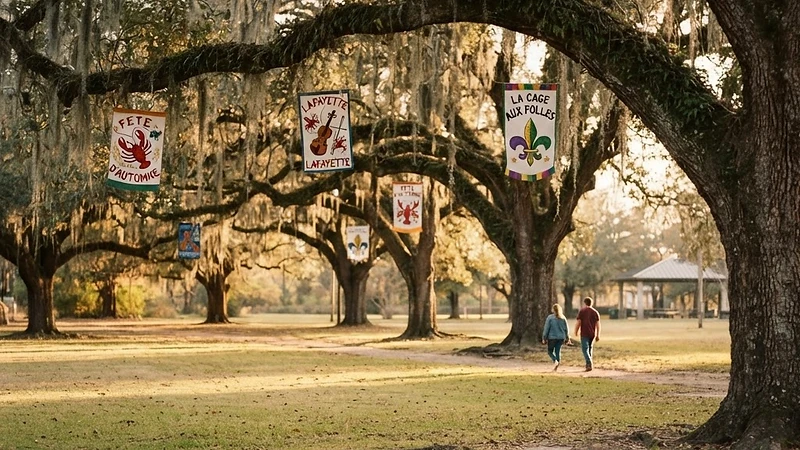
Girard Park opens its gates October 8–11 for the 52nd edition of Acadiana's biggest cultural celebration. Here's what to know before you go.
Under the Oaks: Festivals Acadiens et Créoles Returns for Year 52
There is a weekend every October when Lafayette stops explaining itself. The food trucks line the edges of Girard Park, the oak trees fill with the sound of an accordion being tuned, and somewhere between the boudin booth and the dance floor, the whole argument about what this place is quietly resolves itself. It is Festivals Acadiens et Créoles weekend, and this year it returns October 8 through 11 for its 52nd edition.
A Festival Born of a Revival
It is easy to forget that this celebration almost never existed. Festivals Acadiens et Créoles has its roots in the cultural revival movements of the 1970s, when a generation of Cajun and Creole musicians, cooks and organizers decided that the traditions they had inherited were not relics to be stored away but living things worth building a future around. Three separate gatherings — devoted to the music, the foodways and the craft of the region — eventually merged into the single festival that now fills Girard Park each fall. Fifty-two years later, the math is remarkable: more than five decades of continuous celebration of a culture that, within living memory, schoolchildren were once punished for speaking. The festival is not a museum piece. It is proof that a culture that survived by stubbornness can thrive by joy.
Six Stages, One Weekend
The heart of the festival is its music, spread across six stages under the oaks, and the 2026 lineup does what the best lineups here always do: it puts the icons and the inheritors on the same bill. Steve Riley and the Mamou Playboys — as close to festival royalty as Acadiana has — share the weekend with Jeffery Broussard and the Creole Cowboys, the rubboard-and-accordion sound of zydeco at its most electric. Around them, a new generation of Cajun and Creole artists carries the music forward, some of them grandchildren of the very people who played the first festivals in the 1970s. Go early in the day if you want a spot close to the dance floor. The two-step crowd at Festivals Acadiens is serious business, and by late afternoon the ground in front of the main stages is a full-on fais do-do.
The Food Is the Point
Let us be honest about the hierarchy of attractions: the music is the soul of the festival, but the food is the reason you will come back Sunday after going Saturday. Boudin, gumbo, jambalaya, cracklins, crawfish étouffée — cooked by the church groups, local vendors and family operations who have held the same corner of the park for decades. This is not festival food in the funnel-cake sense. This is the cuisine of Acadiana doing what it does in its own backyard, at prices that still make sense.
More Than a Party
What makes Festivals Acadiens et Créoles worth covering year after year is not any single act or dish. It is what the festival says about the 337. In a region that has taken its share of economic body blows over the decades, this weekend is the annual evidence that the deepest resource in Acadiana was never under the ground. It was in the kitchens, the dance halls and the living rooms where the language and the music were kept alive by hand, one song and one supper at a time. The festival is free. Bring a chair, bring your family, bring somebody who has never heard a tit fer played live. The rest will take care of itself.
If You Go
Festivals Acadiens et Créoles runs Thursday, October 8 through Sunday, October 11, 2026, at Girard Park in Lafayette. Admission is free, with six stages of Cajun and zydeco music, food vendors, and fine crafts throughout the grounds. Find the full schedule at festivalsacadiens.com.
